How Toine Rademacher Saves Around Two Hours on Every Elementor Project
Toine Rademacher on using Skelementor to move from an empty Elementor canvas to a working website structure faster, especially when budgets and timelines are tight.

Building websites when every hour matters
Toine Rademacher works as a web and creative designer through his freelance business, Toine.Zip, while also working with Uw Computerstudent. He designs and develops WordPress websites and webshops for smaller businesses using Elementor and WooCommerce.
Many of those projects come with relatively small budgets. There is not always room for a lengthy discovery phase, a complete UI design in Figma, several rounds of visual concepts, and then a separate development process. Often, Toine needs to move directly into Elementor and start building.
When an entire website has around 15 hours available for production, spending several of them figuring out basic page structures can quickly eat into the project. Efficiency is not merely convenient; it creates more room for the work that makes the site useful and distinct.
Discovering Skelementor early
Toine first came across Skelementor through the Elementor community on Facebook, while the component library was still available for free. He started experimenting with it and found that the sections were useful for more than copying a complete design into a website.
They gave him somewhere to start. When Skelementor later introduced paid plans and a lifetime license, the library was already part of his workflow. He purchased the lifetime license and continued using it across projects.
“I already used the free components a lot - not really to completely build the website only with those copy-paste components, but also to give myself some inspiration.”
Getting past the first design decision
One of the hardest parts of a small website project can happen before much has actually been built. A client might say they need a product section on the homepage, but that requirement still leaves dozens of questions about arrangement, hierarchy, content, and how the section should fit into the rest of the page.
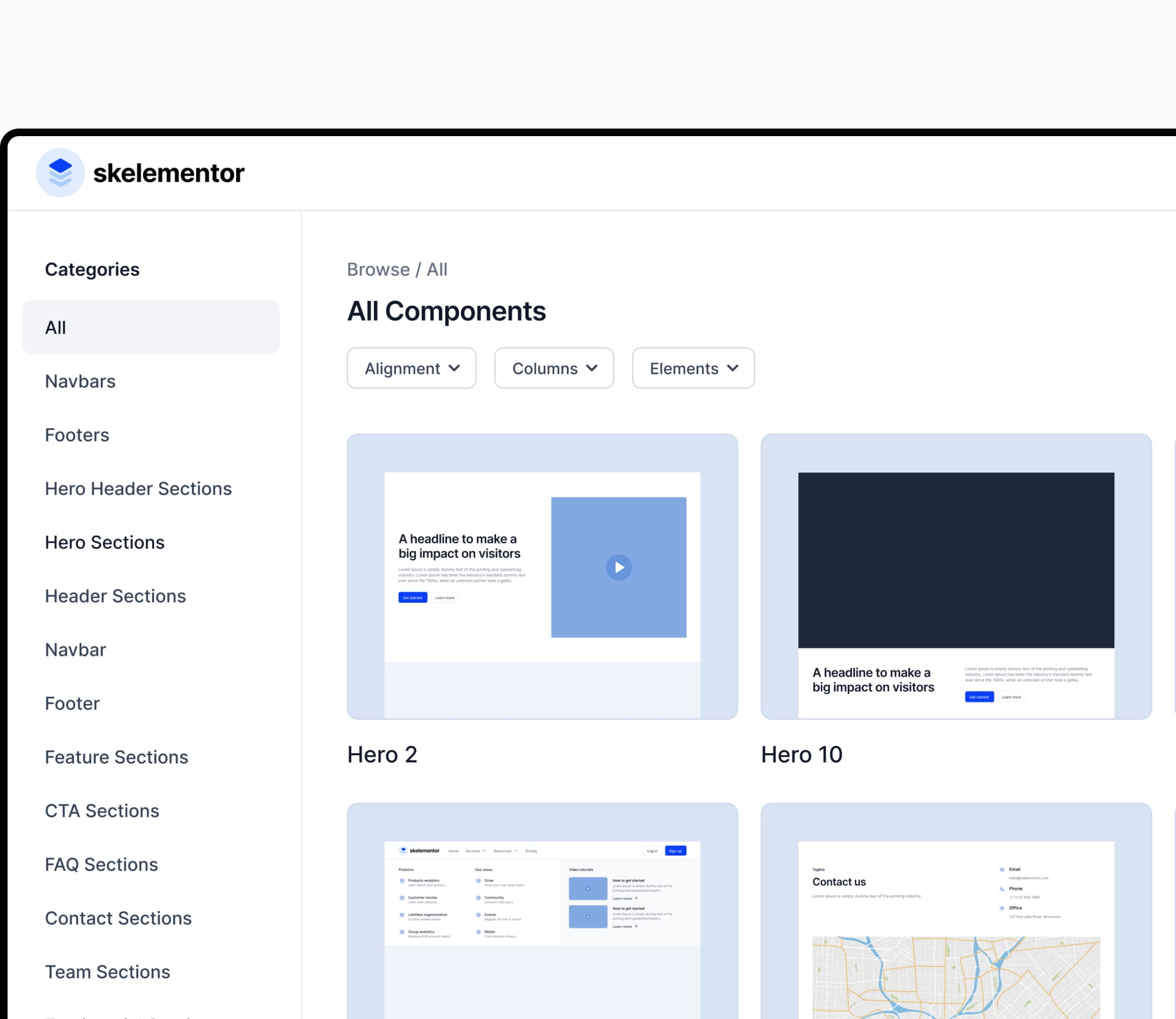
Trying every possible direction manually takes time. Instead, Toine can browse existing Skelementor components and use them to explore what could work. Sometimes a component provides inspiration. Sometimes it helps a client react to a possible direction. Sometimes it is already close enough to become the foundation of the final section.
The value is not having Skelementor build the entire website for him. It is having a faster way to answer the question: what should we build here?
Building the skeleton first
The biggest time saving comes at the beginning of a project. Rather than creating every section manually, Toine can quickly assemble what he describes as a skeleton website.
For a bakery, that might mean establishing a hero, a call to action, a USP section, and a product section. The finished copy, photography, colors, and smaller design decisions can come afterwards. The first objective is to create a structure that Toine and the client can react to together.
Once that structure exists, the work becomes more concrete. Toine can add the real content, replace imagery, connect the website's global styles, and refine each section instead of spending the same time constructing every starting point.
“The best part is to have the layout set up quickly. So then you can just put in the content and then tweak it to your liking.”
Around two hours saved per project
Toine gave a specific estimate for the improvement. The website projects he described can take around 15 hours in total, and he estimates that Skelementor saves at least two hours per project, particularly during the opening phase.
In his estimate, that is roughly 10-15% of the total project time. On a project with only 15 hours available, the difference is significant. Those hours can go toward content, client feedback, styling, functionality, responsive adjustments, and final refinement instead.
Across many projects, the saved time compounds. More importantly, it is returned at the point where a blank canvas would otherwise slow down both creative decisions and client communication.
“Around two hours per project at least - especially at the beginning part.”
A faster starting point for WooCommerce
Toine finds Skelementor particularly useful for WooCommerce components. Elementor provides the tools needed to style WooCommerce widgets, but doing that manually for every element can become repetitive.
Skelementor gives him a starting point that already feels polished without imposing a strong visual identity. He can bring a component into the project, connect it to the site's global styles, adjust colors and typography where necessary, and continue much closer to the finished result.
That neutrality is important. The component can remove repetitive setup while leaving Toine free to shape the website around the client's brand.
“It looks professional, but it's still like a really neutral design.”
A reference for better Elementor builds
Skelementor has also become useful beyond Toine's own client projects. At Uw Computerstudent, he works with people who sometimes help clients with WordPress and Elementor, including colleagues who are still learning how to structure more complicated sections.
Instead of explaining a product archive, Loop Grid, or other section only in theory, Toine can bring a Skelementor component into Elementor and use it as a practical example. The library becomes something his colleagues can inspect and learn from, not only a collection of sections they can use.
“It's really nice to also learn from it - not just to use it in practice for clients, but also for my colleagues to learn: how can you create good best-practice Elementor sections?”
Bringing the same idea into Elementor V4
As Toine has started working more with Elementor V4, the same desire to avoid repetitive setup has carried into his styling workflow. Creating a complete system of classes and design tokens manually for every new site can become another project in itself.
He has begun using Skelementor CSS as a ready-made atomic class system. Instead of building the entire design-token foundation himself, he can start with an established system and adapt its colors and fonts for the project.
It follows the same principle that made the component library valuable to him: do not spend limited project time rebuilding a strong foundation that already exists.
More room inside a tight budget
Toine describes his approach as finding fast, creative solutions when budgets or deadlines are tight. Skelementor does not remove design decisions, client feedback, or the work required to make each website appropriate for the business.
What it reduces is the time needed to reach the first useful version. Toine can establish the structure quickly, put something tangible in front of the client, and spend more of the project's limited time refining what actually matters.
For Toine, that can mean roughly two hours returned on a 15-hour website build. When every hour is part of a tight budget, that is time worth saving.