Smaller website projects for advertising clients: Petter’s approach
Petter uses Skelementor to reduce repeated component building when a Google Ads client needs a better website but cannot fund a complete rebuild.

A Google Ads campaign can bring people to a website without giving them a good reason to become customers. Petter A. H. Langdalen saw that problem in his agency's work: the advertising metrics could look healthy while the website remained a weak point. Some clients could not afford a full rebuild. Skelementor gave his team a quicker way to assemble the components for smaller website projects, reducing repeated construction work when the available budget called for a more limited intervention.
The website matters after the click
Petter runs a digital marketing agency in Norway, working mainly on websites and Google Ads. At the interview, he described a team of about five people plus freelancers. Its clients span different industries, with a focus on service businesses and lead generation.
The agency's interest goes beyond delivering a website as a digital business card. Petter enjoys conversion optimization, landing pages, testing, and working on the text around advertising campaigns. That makes the page a visitor reaches part of the same problem as the advertisement. Improving the destination can require website work even when the client is not ready for a large project.
A smaller budget still leaves components to build
Petter described taking on Google Ads clients whose click-through rates and cost per click looked fine, but whose websites were not converting visitors. The obstacle was the cost of replacing the entire site. There was a need for a more practical way to deliver website work within a smaller scope.
Building every component individually adds effort even when the result is only a few pages. Petter estimated that a component built from the ground up might take around 15–20 minutes. On larger websites, some of that effort can be spread across repeated uses. Smaller projects offer fewer opportunities to recover the initial construction time in that way.
He had also explored a workflow for converting Figma designs into Elementor, but found that approach less straightforward at the time. Skelementor's copy-and-paste method gave him a way to work directly with structures that could be used in the page builder.
Choose the section while the page takes shape
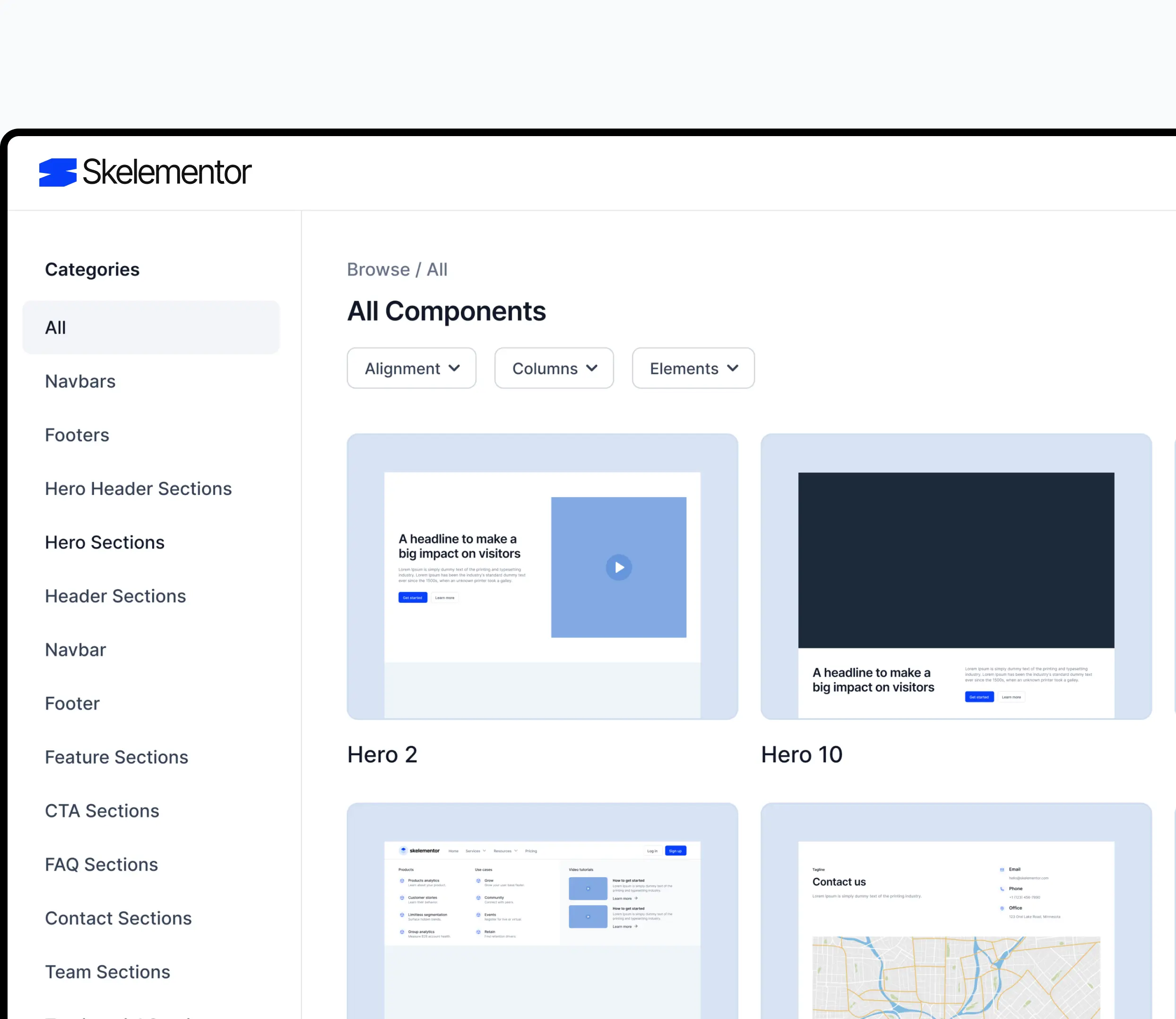
The appeal for Petter is a short path from choosing a component to working on it in Elementor. He sets the site's global colors, finds the section he needs in Skelementor, copies it across, and adds the relevant text. His account focuses on those everyday steps rather than on a large collection of additional features.
At one stage, the agency used Relume for wireframes and found useful matches between those structures and the Skelementor library. That helped connect a planned layout with a component that could be brought into Elementor. Later in the interview, Petter explained that his wireframing process had changed: he was using AI with Figma to develop drafts. The reusable sections remained useful even as the planning tools changed.
He also likes to leave some decisions open while building. Browsing can surface an interesting component he had not considered during wireframing. The page can develop through those choices, instead of every section being fixed before the team enters the builder. This is part of why the library is useful to him as a working resource.
Petter selects components as he goes, matching each choice to the page taking shape. His method works without first organizing an extensive personal library. He could see himself saving frequently used sections in the future, but at the time of the interview his starting point was the catalog and the immediate requirements of the job.
The project size changes the value of that method. Petter singled out websites of one to five pages, where copying a ready-made structure avoids an initial build that may otherwise have little reuse. The team still needs to supply the page's content and make the choices appropriate to the client.
“if you set your global colors, then you're pretty much set to go.”
The clearest comparison is at component level
Petter's most concrete time comparison concerns a component. He estimated around 15–20 minutes to build one from the ground up, compared with about five minutes to bring in a Skelementor section and put in the text. Those are approximate timings from his experience, not the results of a timed test.
Asked about savings on a typical project, he also offered an estimate of 60–80%, then immediately explained that the outcome depends on project size. Smaller websites benefit particularly from avoiding the initial construction of each section. Bigger projects already allow more reuse once their components have been built.
The component comparison identifies the part of the work that changes. There is a structure ready to copy, so the team can move straight to adding the content and applying the site's styling. A larger website still has its own requirements, and Petter's estimate changes with the amount of reuse the project would already allow.
Reducing that initial effort fits the problem Petter described: a client needs website improvements but may not be ready to commission a full rebuild. It also fits the agency's emphasis on setting honest expectations. Petter wants clients to understand what is possible, what is uncertain, and what the team can actually deliver. Reusable sections help him scope the production work; the page's performance still needs to be evaluated through the advertising and testing work that follows.
Match the build effort to the size of the job
For an agency that handles both advertising and websites, Petter's experience points to a useful question: how much of a small project is spent creating structures the team has built before? Reusing those structures can leave a more practical starting point for the work a client actually needs.
Begin with the scope, set the site's shared styling, and choose components that support the page's content. Keep the performance questions separate and test them after the page is in use. Petter's story shows where production effort can be reduced; the advertising and conversion work still depends on the choices his agency makes for each client.