A cleaner starting point for Workly Group's evolving website
Kim Wahlman uses Skelementor to add pages to Workly Group's existing website, applying his own design to reusable, responsive section structures.

Kim Wahlman usually has a page in mind before he opens the builder. As Marketing Manager at Workly Group, he maintains a single HR-tech company's website, adding pages and content as the business needs them. His problem was the amount of ready-made styling he had to remove before applying that direction. Skelementor gave him a cleaner foundation: copy a section, bring in his own design, and continue developing the website he works on every day.
A marketing website that keeps changing
Kim works in marketing for Workly Group, an HR-tech company serving small and midsize businesses in Sweden. The company's website runs on WordPress and Elementor. His responsibilities include maintaining that site and creating new content, pages, and blog posts around it.
He brings years of experience with Elementor to that work. The recurring task is developing one established company's website, with its existing identity and a continuing need for content. Kim's use of Skelementor belongs to that setting. A useful section has to help him create another page within the website he already manages and has a clear visual direction for.
Too much to remove before adding his own design
Before using Skelementor, Kim drew on premade Elementor sections, including footers. He found they came with visual material he did not need, leaving him to redesign them before they suited his website. The starting point was available, but turning it into his own design involved cleanup each time.
That work sat awkwardly with how he thinks about a page. Kim describes beginning with a visual mind map: the intended design is already taking shape in his head. What he wants from a library is an understanding of the component structures he can use to build it. A complete visual design can bring additional decisions he then has to undo.
Responsive behavior adds another consideration. A page needs a structure that can adapt across screen sizes, alongside the visual direction he wants to apply. Finding a useful baseline for both parts would let him spend less time preparing the section before making it his own.
Find the building blocks for the page already in mind
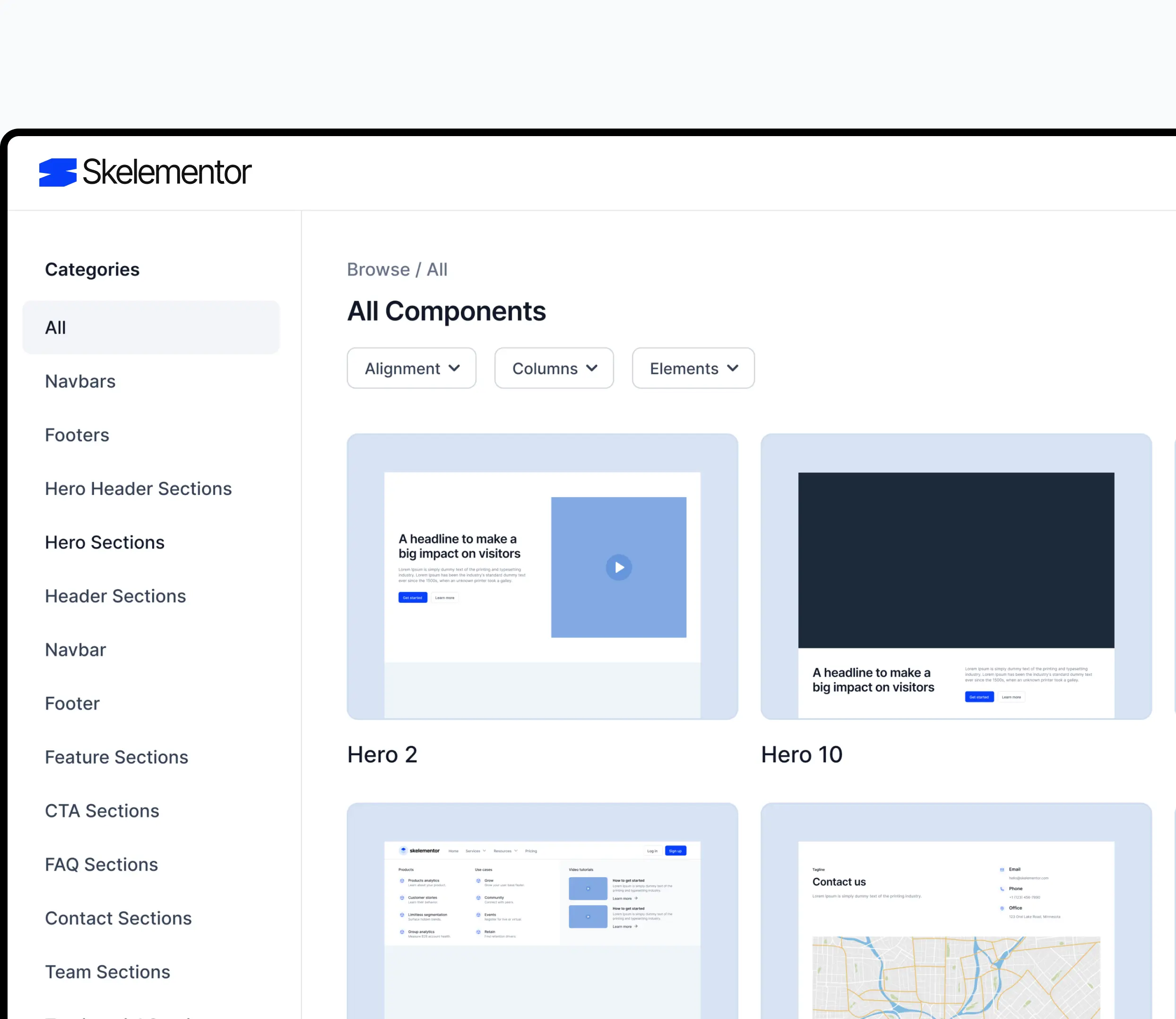
Kim discovered Skelementor through a recommendation on Reddit, checked it out, and saw components that looked useful for his work. The company obtained a lifetime license. His day-to-day use centers on browsing for inspiration and copying sections into the existing Elementor website.
The appeal is the baseline. Kim can look through the available structures and connect them with the page he wants to make. Once a suitable component is in place, he can apply his own design directly. He describes having less of the premade appearance to strip away before doing that work.
His use spans several kinds of sections. Heroes and feature sections are the ones he thinks he has used most. He also names headers, timelines, calls to action, pricing, contact sections, and FAQs. That range matters in a website he continues to develop: different page needs can draw from the same library of foundations.
Copy and paste is central to the process. The section moves from something he can inspect in the library to a structure he can work on in the website. It gives him a concrete basis for the design decisions he has already started making mentally, with a responsive framework he finds helpful.
Kim also uses the library as a source of ideas. Seeing the available components helps him think about what he could build, while the website's design remains his responsibility. The starting structure can contribute both a practical section and another way of approaching the page.
That is the balance he values: enough structure to use immediately, with space to apply the site's own visual language. He is interested in more experimental options too, but recognizes that highly specific designs will have a narrower fit than the broad building blocks he uses regularly.
“I always have a visual mind map when I start building pages.”
Less preparation before the page becomes his own
Kim tentatively estimates that Skelementor saves around 30% of his time. That is his assessment of creating pages and maintaining the company website. His work does not involve delivering new sites for outside clients, so the estimate belongs to the ongoing page work he describes.
The change he explains most clearly is avoiding repeated design cleanup. He can begin with a baseline and add his intended design, instead of spending the opening stage removing an existing one. For someone who already pictures the page, that makes the supplied component more directly useful.
He also identifies responsiveness as another source of time saved. In his experience, the section's framework is largely prepared, allowing him to concentrate on applying the visual direction. He does not separate that benefit into its own measured figure; it is part of why he finds the starting structure helpful.
The broad range of sections supports that ongoing use. Kim can return for another hero, feature area, FAQ, or contact section as the site develops. His preference is for foundations he can make his own across those different needs. The value lies in repeatedly reaching that useful starting point.
When discussing future additions, Kim sees a place for experimentation but also appreciates the practical baseline. He considers more variations within familiar section types useful too. That preference reflects his current task: keep developing a company's website with structures that can fit its design, rather than introducing a new visual direction with every component.
Choose a foundation that leaves room for the existing site
For marketers maintaining an established website, Kim's process starts with the intended page. Work out the direction, look for the component structure that supports it, and apply the site's own styling. The useful question is how much preparation remains between importing a section and working on the design you actually want.
A library can help on that everyday scale, across one company's continuing website work. Kim returns for familiar section types, responsive foundations, and ideas he can adapt. His experience shows the value of a restrained starting point: enough of the construction is available to move forward, while the existing website and the person maintaining it continue to determine the finished appearance.