How Karel Demeersseman Builds Elementor Websites Faster Without Starting From Scratch
Karel Demeersseman on using Skelementor for design inspiration, faster page building, and a more efficient Elementor workflow.
Building directly in Elementor
Karel Demeersseman has been building websites with WordPress and Elementor for around six years. As a solo freelancer, he works directly inside Elementor rather than following a traditional design-to-development process for every project.
Rather than designing a complete website in Figma and recreating it in WordPress, he prefers to shape the page directly in Elementor. That gives him room to experiment quickly, but when every section begins with a blank canvas, that experimentation can become expensive in time.
The problem with starting from scratch
Before Skelementor became part of his workflow, Karel built sections manually. A hero could take significant time to design, adjust, and test, only for him to decide the finished result was not working and begin again with another layout.
That cycle was particularly time-consuming while he was still becoming comfortable with Elementor. Building the website was only one part of the work; finding the right visual direction required its own round of trial and error.
“You would design a hero section and then when it's pretty much, 'Oh, this is crap,' let me just start basically from scratch again.”
Finding Skelementor early
Karel discovered Skelementor relatively early in its life. He remembers coming across it through YouTube when the library was still available for free, started using it, and continued after Skelementor officially launched. He eventually became a lifetime customer.
What began as access to pre-built Elementor sections gradually became part of how he approaches new designs. Instead of asking how to construct every section from nothing, he can first explore what already exists.
Inspiration before construction
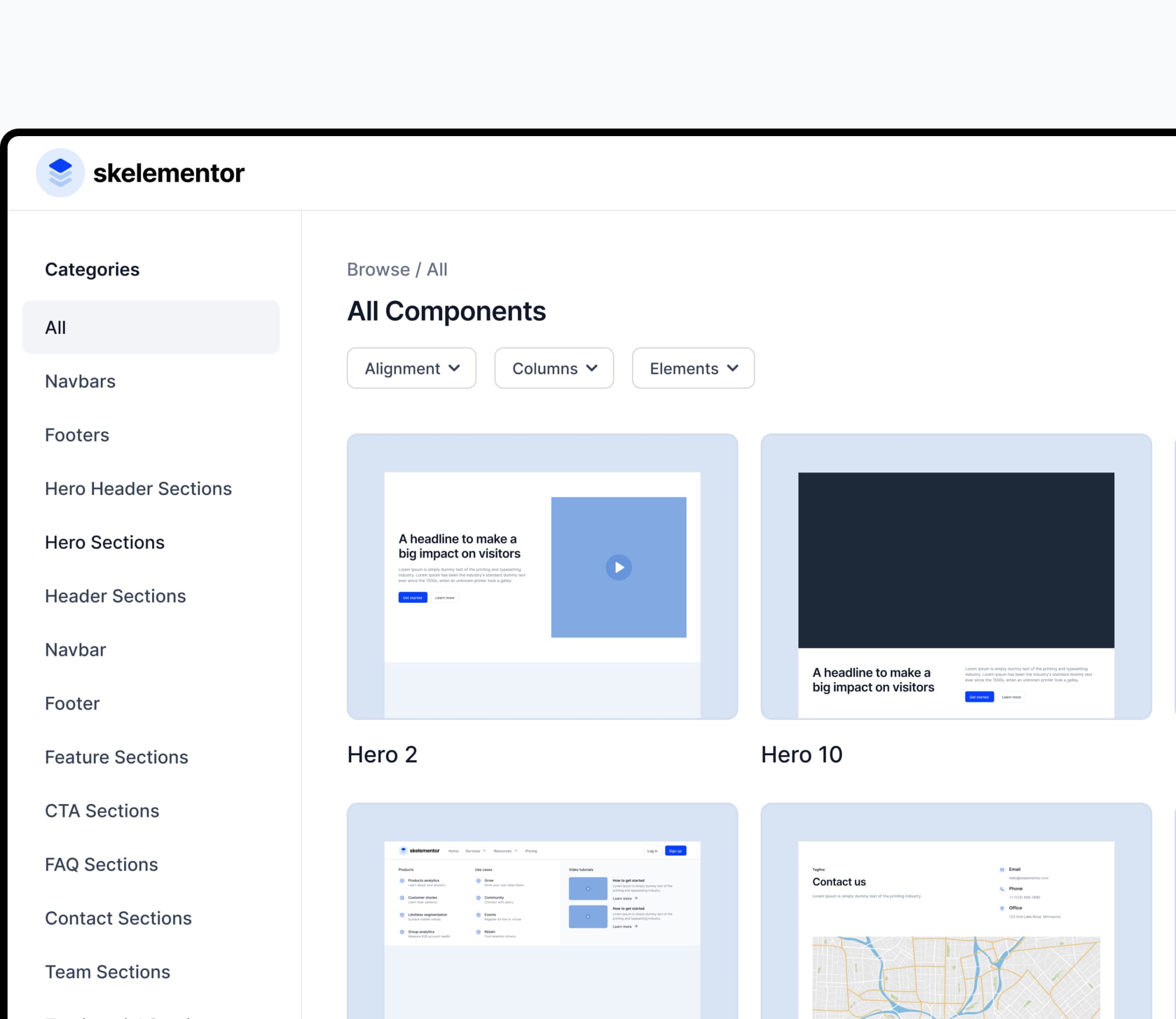
Today, Karel primarily uses Skelementor for design inspiration. When he needs a hero, he can browse different approaches immediately, take a structure from one section, borrow an interesting element from another, and combine the ideas.
The component does not have to become the final design. Sometimes it simply gets the process moving. Instead of staring at an empty Elementor canvas, Karel can begin with professionally designed possibilities and shape them around the project.
“I need a hero section. I just hop on Skelementor and see all the hero sections. This is interesting. This is interesting. Let me copy this from this section and maybe combine it with the other thing from that section.”
From idea to working section faster
When a Skelementor component is already close to what a project needs, Karel can bring it into Elementor, replace the imagery and content, and immediately judge how it feels in the context of the website.
If it works, he continues. If it does not, changing direction takes far less effort than rebuilding the section. Karel is still choosing, combining, adapting, and refining; Skelementor simply makes those decisions faster and experimentation more lightweight.
“Some sections are already perfect for the project I'm working on. So I just throw it in there. I put some images on there and see, okay, is it good? If it's not good, okay, I just choose another one.”
A faster way to experiment
The overall website-building process is now noticeably more efficient. Reusable sections shorten the loop between having an idea and evaluating it, so Karel can test, reject, replace, combine, or develop a layout without investing the same amount of time at every stage.
He does not attach an exact percentage or financial figure to the improvement. The value is simpler: Skelementor consistently saves him time, and for a freelancer, that time matters.
“It's hard to say how much money that saves you, but it definitely saves you a lot of time. And time is, in our way of work, priceless.”
Why rebuild something that already exists?
Karel's experience comes down to a straightforward idea: a web designer does not need to prove their creativity by rebuilding every familiar website pattern manually.
The real value is in deciding what the page needs, choosing the right structure, adapting it to the client, and turning those pieces into a website that works. A useful building block gives more time back for those decisions and creates a faster path from an initial idea to a section he can use.
“Why would you start from scratch every time? That's basically not the smarter way of working.”
Less blank canvas, more building
Karel still brings his own judgment to every project. Skelementor does not decide what looks right or what makes sense for a particular website; it removes part of the repetitive work required to get there.
He can browse existing ideas, bring the most relevant ones into Elementor, adapt and combine them, then move forward. For a solo freelancer who builds directly in Elementor, the process becomes less about reconstructing common patterns and more about deciding how they should work for the website in front of him. Inspiration arrives faster, experimentation costs less time, and the whole build becomes more efficient.