How Marqeter AI Turns Website Ideas into Client-Ready Drafts Faster
Faustas Nazarovas on using Skelementor to prototype pages, standardize client design systems, and reduce repetitive Elementor work.
From abstract ideas to visible direction
A good website draft changes the conversation. Instead of discussing an abstract layout, a team can react to something visible. A client can confirm the direction. A designer can refine an idea that already has structure. For Faustas Nazarovas, Skelementor made that moment arrive much earlier.
One founder, several roles
Faustas is the founder and SEO expert behind Marqeter AI, a small search marketing company based in Sweden. Its team combines proprietary technology with hands-on work across SEO, analytics, conversion optimization, content, website design, and development. The company primarily serves B2B businesses in finance and education.
Like many founders running a compact agency, Faustas moves between roles. On a typical day, he may be working as a technology lead, handling operations, developing an internal tool, or building a website. Time spent recreating familiar page structures is time taken away from strategy and client work.
He began building websites at 15 and originally coded them manually. Elementor later gave him a visual way to work that suited how he thinks. It was considerably faster than starting from code, but it did not remove every bottleneck.
Elementor made building faster. Repetition remained.
As Faustas used Elementor more frequently, the same problem kept returning: common sections had to be rebuilt, rearranged, and restyled from one project to the next. Even when the design direction was familiar, getting from an idea to a presentable draft still demanded substantial setup.
This was especially limiting at the beginning of a project. Clients often need something tangible before they can give useful feedback, but creating that first visual direction can pull a team into a full design process before the underlying structure has been validated.
Faustas wanted a quicker way to assemble a credible page, discuss it internally, and show it to a client without treating the first draft as the finished design.
Finding Skelementor
Faustas discovered Skelementor through a Google search. He joined the Facebook community, saw that new components were being released every week, and signed up soon after.
What started as a source of reusable Elementor sections became part of his regular workflow. He now uses Skelementor frequently for client work and for internal discussions with his co-founder.
A working canvas for early ideas
When Faustas and his co-founder need to discuss a landing page, they can open a WordPress sandbox, bring in relevant Skelementor sections, and assemble a page while the idea is still being shaped. The page becomes a working canvas rather than a blank screen.
That distinction matters. A list of requirements can leave room for several interpretations. A visual draft makes the hierarchy, sequence, and missing pieces easier to see. The team can ask better questions before spending time on detailed design.
How the workflow now works
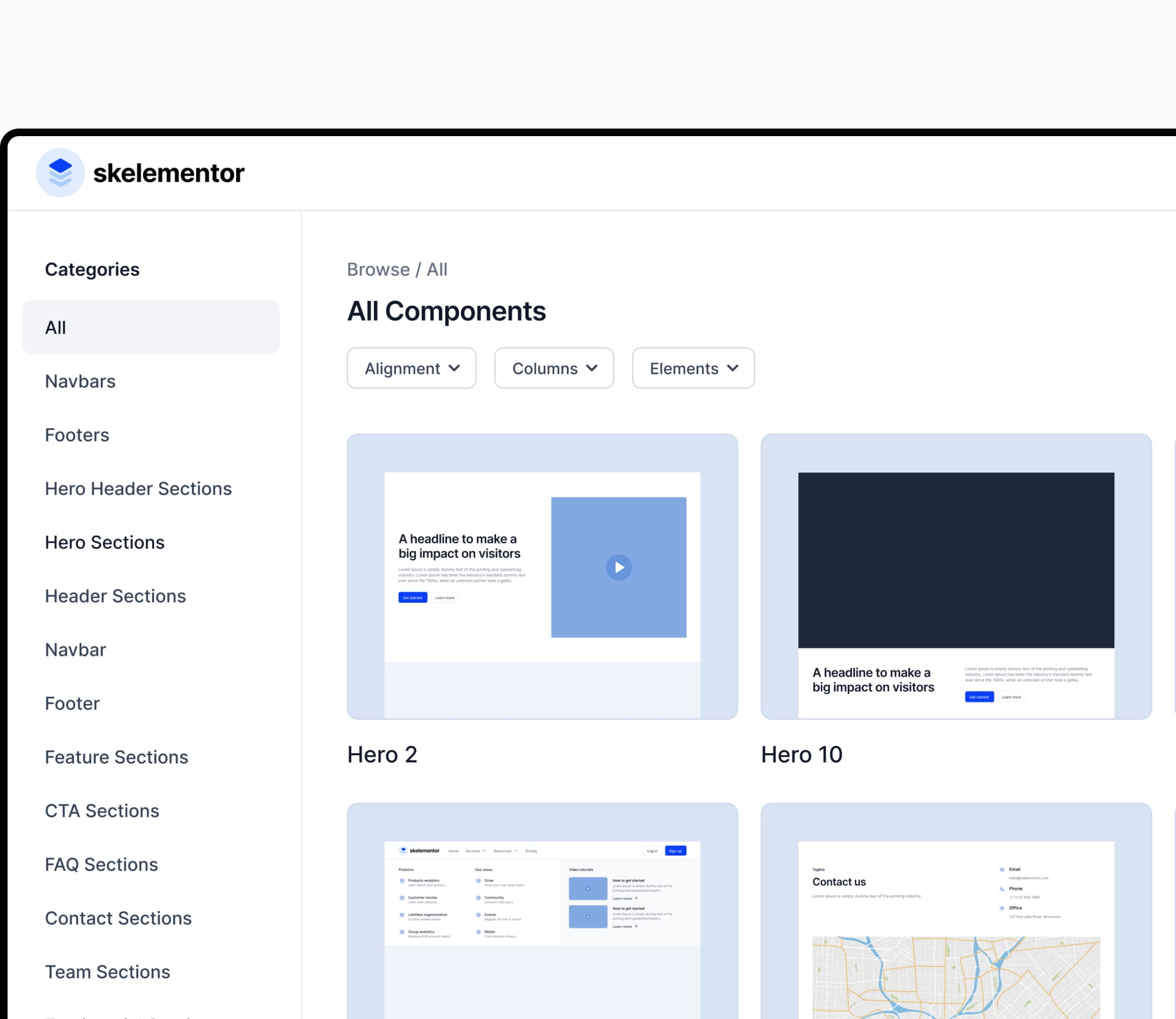
Faustas starts with a real page, not an empty canvas. He selects suitable sections from the Skelementor library and assembles them inside Elementor. He is not treating the components as a final template. They provide enough structure to test the page as a whole.
The selected sections are adjusted to match the client's content, brand, and priorities. This gives Marqeter AI a useful middle ground: faster than designing every section from scratch, but flexible enough to avoid delivering the same visual language to every customer.
Once the draft communicates the direction clearly, Faustas can send it to the client for an initial response. The client is reacting to a credible page rather than trying to imagine one from notes or a call.
After the client approves the direction, the draft goes to a designer for refinement. The team then returns to the client with a more polished version. The designer enters the process with clearer constraints, while the client has already validated the main structure.
Building a client-specific library on top of Skelementor
Faustas did not stop at copying individual components. He created his own internal layer of reusable sections for different clients. A section could be adapted once to a client's colors, typography, border radius, and design rules, then reused whenever that business needed another page.
He jokingly described it as a 'Skelementor Marqeter Edition': a client-specific system built on top of the original library. Instead of repeatedly copying a blue Skelementor component and restyling every detail, Marqeter AI could begin with a version that already spoke the client's visual language.
For an agency serving multiple companies, this turns reuse into a practical operating system. Skelementor supplies the structural starting points; Marqeter AI adds the context, brand decisions, content architecture, and strategy unique to each client.
Simplifying the styling layer with Skelementor CSS
Before Skelementor CSS, Faustas had been developing an internal solution for managing reusable client styles. It worked, but it was more technical than the team needed. Once Skelementor CSS covered the basic requirements, he replaced much of that setup with the simpler system.
His initial use has focused on fundamentals such as font styles and colors. Even at that level, the value is clear: changing a design system at the source is more efficient than correcting individual sections across a growing collection of pages.
Faustas expects his use of the styling system to deepen as the product develops. For now, it has already reduced the need to maintain a separate, technically heavy solution for common design decisions.
The result: a good draft, much earlier
Faustas estimates that designing a website with Skelementor now takes roughly one-third to one-half of the time it previously required. The estimate is based on his own workflow rather than a controlled time study, but the operational change behind it is specific.
Time improves because the team starts from reusable structures instead of reconstructing familiar sections. Feedback improves because clients can respond to a visible draft earlier, when changing direction is less expensive.
Standardization improves because client-specific section libraries preserve design decisions across new pages. Handover improves because designers receive a draft with an approved structure instead of beginning with an unresolved brief.
The benefit is not simply producing more pages. It is getting a credible draft into the conversation sooner without lowering the quality of the starting point.
Why this fits Marqeter AI's approach
Marqeter AI does not treat design, development, and SEO as separate stages. The team builds them together from the beginning. Its websites are planned as topical authority platforms: content is structured around entities, search intent, semantic relationships, conversion paths, and long-term growth.
That philosophy makes speed useful only when it supports strategy. Skelementor helps the team express a direction quickly, but the components still need to be shaped around the customer's audience and business goals.
Faustas's advice to business owners is simple: do not start with the design. Start with the strategy. Every page should have a purpose before a single pixel is designed.
Experimenting with AI-assisted page assembly
Faustas is also testing what happens when reusable sections are combined with AI and Elementor's structured data. In an internal experiment that is still in development, he can describe the page he wants, allow the system to select relevant sections from the Skelementor library, and generate an initial page structure.
This is not a finished Skelementor feature or a replacement for strategy. It is an example of why a well-organized component library becomes more valuable as workflows become more automated. AI can help arrange building blocks, but those blocks still need clear structure, useful variation, and professional design decisions.
A faster route from thinking to showing
Skelementor has become more than a component source inside Marqeter AI. It supports brainstorming, early client communication, reusable design systems, and the handoff between strategy and detailed design.
The expertise still comes from Faustas and his team: understanding the client's market, planning the information architecture, shaping the message, and knowing what the website needs to accomplish. Skelementor removes part of the repetitive setup so that expertise can appear on the screen sooner.
For a founder who moves between SEO, technology, operations, design, and development, that earlier draft is a meaningful advantage. It creates a shared object the team and client can improve together.